
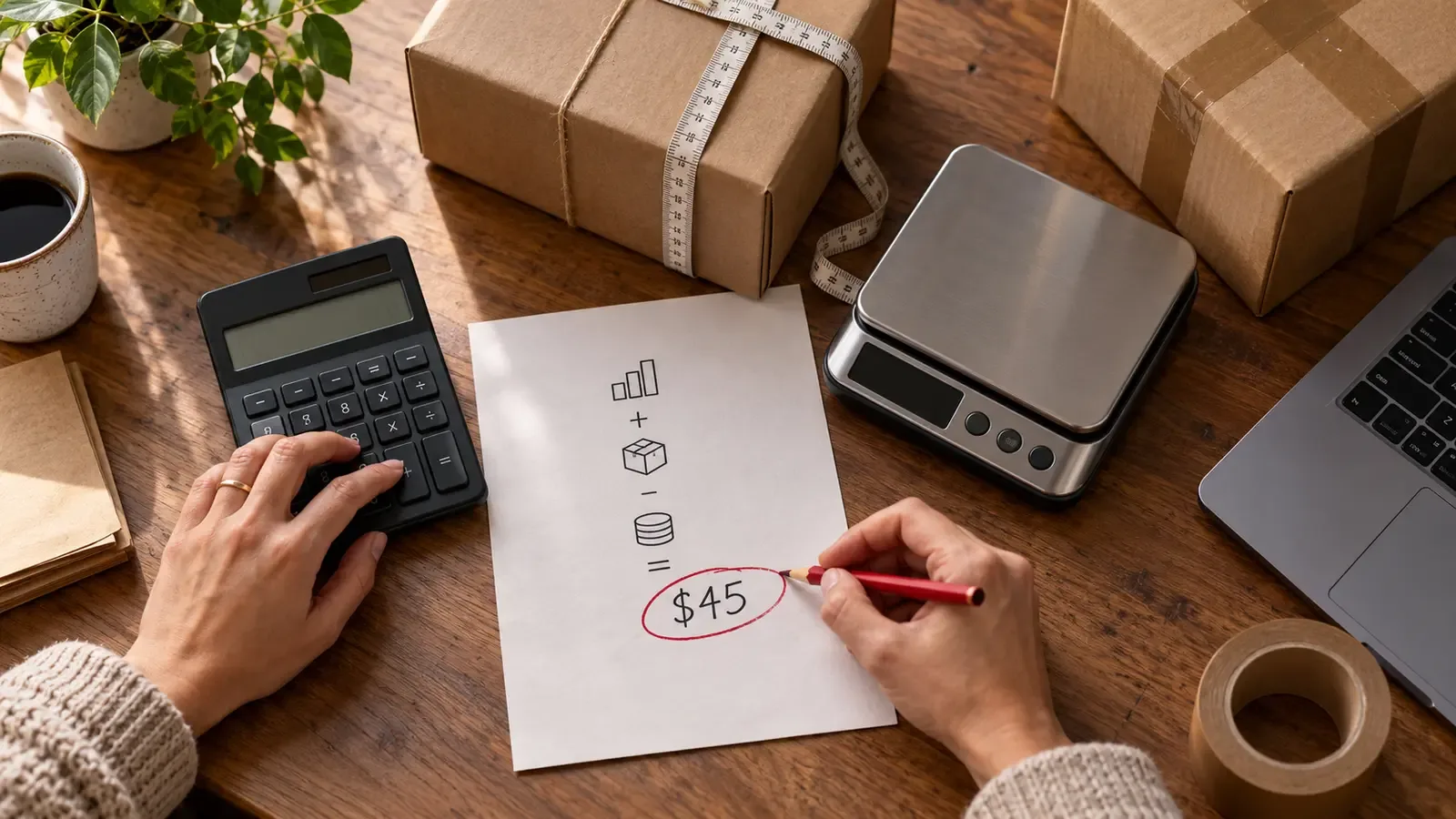
A profitable Black Friday free-shipping threshold is not a competitor’s round number. Calculate it from your post-discount contribution margin, average eligible shipping cost and the profit you still want each order to leave behind. The practical formula is:
Free shipping threshold = (average shipping cost + target order contribution) ÷ contribution margin rate
If your post-discount contribution margin is 45%, eligible shipping averages $8 and you want at least $12 left after postage, the result is $44.44. A $45 minimum is a defensible starting point. Then test it by destination, package size and basket mix before advertising it for Black Friday.
Why the threshold matters more during Black Friday 2026
Adobe’s September 28, 2026 forecast expects U.S. online holiday spending to reach $275.1 billion from November 1 through December 31. It projects Black Friday at $12.9 billion, up 9.2% year over year, and Cyber Monday at $15.1 billion. These are market forecasts, not a promise of sales for one store, but they show why a shipping offer should be ready before deal traffic arrives.
Free shipping can remove a visible checkout cost and encourage a larger basket. It can also turn an apparently successful promotion into a loss when it stacks with a percentage discount, expensive destination or oversized parcel. Baymard’s current cart-abandonment research reports that 40% of U.S. shoppers who abandoned for a stated reason cited extra costs—shipping, tax and fees—as too high. The useful lesson is to disclose the offer early and make its economics work, not to hide shipping until checkout.
What a free-shipping threshold actually does
A threshold asks the buyer to increase the merchandise subtotal before the seller absorbs eligible delivery cost. It should do three jobs:
- keep the shipping subsidy below the extra contribution generated by the basket;
- sit close enough to real customer baskets that adding another useful product feels achievable;
- exclude routes, services or products whose cost would break the calculation.
The threshold is normally most useful on a seller-controlled store. Amazon, Etsy, eBay and other marketplaces have their own shipping, promotion and visibility rules. Use the same profit calculation there, but only configure an offer the marketplace actually supports.
Step 1: calculate contribution margin after the Black Friday discount
Do not use the margin from your full-price catalogue. Start with the price the customer will actually pay and subtract every variable cost that changes with the order:
- product or landed cost;
- marketplace, payment-processing or platform transaction fees;
- pick-and-pack labour or fulfilment charges;
- packaging;
- discount funding;
- expected returns, damage or refund allowance;
- other per-order variable costs.
Leave outbound shipping out at this stage because the formula adds it separately.
Contribution margin rate = (order revenue − variable costs before shipping) ÷ order revenue
Use the Profit Margin Calculator to check the post-discount margin, and the Discount & Sale Price Calculator to compare sale prices before choosing a threshold. If you sell through Shopify, run the discounted order through the Shopify Fee Calculator with the payment method and plan you actually use.
Step 2: find the shipping cost the offer must absorb
Use a recent, representative sample of orders rather than the cheapest label you can find. For each eligible order, record:
- destination zone or country;
- service used;
- packed weight;
- box dimensions;
- label cost;
- residential, remote-area, fuel or other applicable surcharges;
- packaging and fulfilment charges if they were not counted earlier.
Calculate the average for the destinations and services included in the offer. Also inspect the upper end of the range. A single national threshold may be unsafe if a remote shipment costs twice the average.
Carriers can charge by dimensional rather than scale weight. Measure the finished parcel with the Dimensional Weight Calculator, using the divisor in your current carrier agreement. A bulky low-cost product can cross the threshold while still producing a costly shipment.
Step 3: choose the profit you want left after shipping
A break-even threshold where the order leaves zero contribution is too weak for most promotions. Choose a target contribution that can still support fixed costs, marketing and profit.
Possible starting targets include:
- your normal contribution dollars per order;
- a lower but intentional event target;
- a percentage of order revenue that management has approved;
- a product-specific minimum where high-return or fragile items need more protection.
The target is a business decision, not an industry benchmark. Record it so the team knows when an offer has moved from deliberate investment to accidental loss.
Worked example: calculate a $45 free-shipping minimum
| Input | Amount |
|---|---|
| Post-discount contribution margin | 45% |
| Average eligible shipping cost | $8 |
| Target contribution after shipping | $12 |
Threshold = ($8 + $12) ÷ 0.45 = $44.44
Round up to a customer-friendly $45 minimum. At a $45 basket, contribution before shipping is $20.25. After an $8 label, $12.25 remains, slightly above the target.
Now stress-test the same basket:
| Scenario | Shipping cost | Contribution left |
|---|---|---|
| Typical eligible order | $8 | $12.25 |
| Remote destination | $14 | $6.25 |
| Oversized parcel | $18 | $2.25 |
The last two orders do not meet the target. The answer is not necessarily a higher threshold for everyone. It may be a destination exclusion, a maximum shipping-rate cap, a separate heavy-item profile or a paid upgrade.
Step 4: compare the result with current basket behaviour
Calculate both average order value and median order value. Average order value can be pulled upward by a few large orders; the median shows the middle basket and may better represent what most customers can realistically reach.
If the calculated threshold is only a few dollars above the common basket, identify useful add-on products at that gap. If it is far above the median, customers may ignore it or add low-margin products that do not improve profit enough.
The guide to increasing average order value explains how bundles and add-ons change basket size. Recalculate the whole basket, because “add $10 to unlock free shipping” does not mean the seller gains $10 of contribution.
Step 5: protect the threshold from promotion stacking
Black Friday orders may combine a sale price, order discount, free-shipping code, loyalty reward or automatic promotion. Test the final checkout result rather than reviewing each offer separately.
For each combination, verify:
- the qualifying subtotal before and after discounts;
- whether gift cards, subscriptions or excluded products count;
- which shipping services become free;
- whether remote, international or oversized rates remain available;
- the final contribution after every discount and delivery cost.
The Black Friday discount strategy shows how to protect the price side of the promotion. Treat free shipping as another discount with a variable cost, not as a harmless checkout message.
Step 6: configure the offer by zone and service
Shopify’s current Help Center says sellers can create price-based shipping rates and select “Offer free shipping” with a minimum order amount. It also notes that rates from multiple shipping profiles can be combined, so a mixed cart needs testing before launch.
A practical setup can include:
- free standard shipping over the threshold for selected domestic zones;
- paid express upgrades;
- a maximum eligible shipping-rate amount;
- separate rates for oversized, refrigerated, dangerous or remote shipments;
- clear international terms rather than one worldwide promise.
Use exact language: “Free standard shipping on eligible domestic orders over $45 after discounts.” Link to the full exclusions and show progress toward the threshold in the cart only when the calculation is accurate.
Step 7: test the offer before Black Friday
Run checkout tests for a compact order, a bulky order, a remote postcode, a discounted basket, a mixed shipping-profile cart and an express upgrade. Confirm the displayed subtotal, rate, delivery estimate and final payment amount.
Monitor these figures during the promotion:
- percentage of orders qualifying for free shipping;
- average and median order value;
- shipping cost as a percentage of revenue;
- contribution dollars per order after shipping;
- conversion rate and cart abandonment;
- refunds, returns and split shipments;
- zones or products creating losses.
Change the threshold or eligibility when evidence shows the offer is unsafe. Do not keep a losing promise live solely because it appeared in the original campaign plan.
A practical Q4 2026 rollout
| Period | Action |
|---|---|
| October 3–18 | Export basket and shipping data, calculate margin, map zones and measure packed parcels. |
| October 19–November 8 | Choose the threshold, configure exclusions and test discount combinations. |
| November 9–22 | Run a controlled test, compare AOV and contribution, then revise the offer. |
| Black Friday–Cyber Monday | Monitor shipping subsidy and contribution daily; stop unsafe combinations quickly. |
| After Cyber Monday | Separate promotional results from normal trade and decide whether the threshold should continue. |
Pair the offer with the 2026 holiday shipping cutoff planner. A profitable shipping offer still needs a delivery promise the fulfilment operation can meet.
Frequently asked questions
What is a good free-shipping threshold for Black Friday?
There is no universal amount. Use the formula based on your post-discount contribution margin, eligible shipping cost and target profit, then compare the result with real basket values.
Should the threshold be above average order value?
Often it is set above a typical basket to encourage an additional item, but the gap must be achievable and profitable. Check the median as well as the average so a few large orders do not distort the decision.
Do discounts count toward the free-shipping minimum?
That depends on the platform and configuration. Test whether eligibility is measured before or after discounts and state the rule clearly in customer-facing copy.
Should international orders receive the same offer?
Only if the economics support it. International postage, customs processes and remote-area charges can differ sharply, so separate zones or exclusions are usually safer than one worldwide threshold.
Can I exclude oversized products?
Yes, when the platform supports separate shipping profiles or product rules. Explain the exclusion before checkout and test mixed carts containing both eligible and oversized items.
How often should I recalculate the threshold?
Recalculate when carrier rates, product costs, sale prices, fee structures, average basket value or packaging changes. During a major promotion, review actual results daily.
Sources and limitations
This guide was checked on October 3, 2026 against Shopify’s free-shipping strategy guide and shipping-rate setup guidance, Baymard’s cart-abandonment research, and Adobe’s 2026 U.S. holiday forecast. Platform settings, carrier prices and promotion behaviour can change. Verify your current checkout, contracts, zones and account configuration before publishing an offer.