
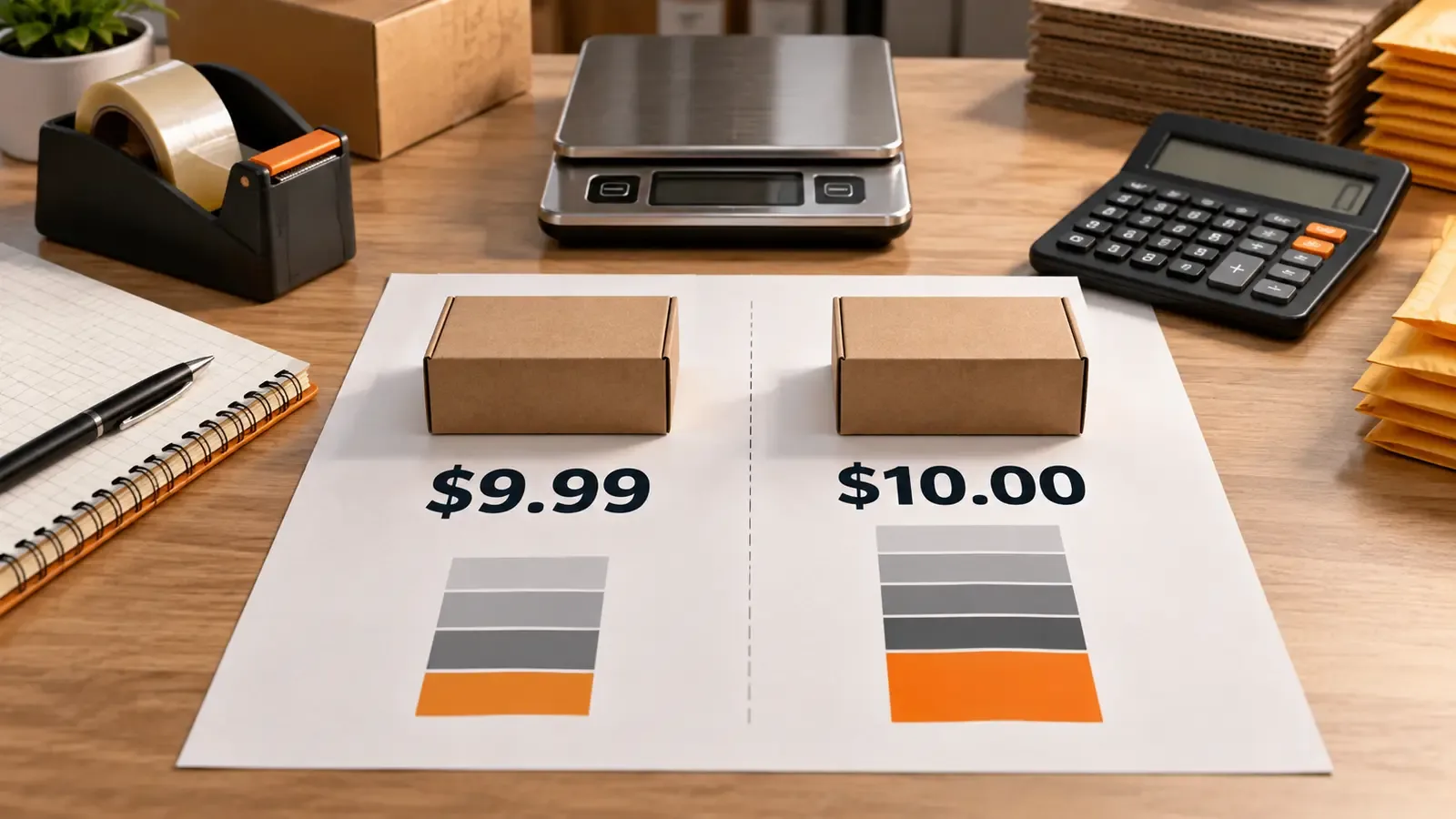
Amazon Low-Price FBA can lower the fulfilment fee automatically when a US FBA product is priced below $10, but the $9.99 decision should be based on total profit—not the fee discount alone. For 2026, Amazon says eligible products receive Low-Price FBA rates averaging $0.86 less than standard FBA rates. The exact difference depends on the product’s size and shipping weight, and Q4 peak fees plus the current fuel and logistics surcharge still matter.
Use the Amazon Low-Price FBA Tier Calculator with the standard and low-price fee estimates for your ASIN. It shows the per-unit and monthly fulfilment-fee saving without pretending one rate fits every product.
What is Amazon Low-Price FBA?
Low-Price FBA is Amazon’s lower fulfilment-fee schedule for eligible FBA products priced under $10 in the US store. Amazon says qualifying products receive the lower rate automatically, so sellers do not enrol each ASIN in a separate programme.
The discount applies to the FBA fulfilment fee. It does not make the rest of the order free. Your product may still incur:
- the category referral fee;
- a selling-plan charge;
- inbound transportation and placement costs;
- monthly and aged-inventory storage charges;
- advertising and promotion costs;
- returns, removal or disposal costs;
- other account- or product-specific fees.
Amazon’s current 2026 guidance says the Low-Price FBA saving averages $0.86 against standard FBA rates. “Average” is not a guaranteed amount for every ASIN. Confirm the exact size tier, shipping weight and fee in Seller Central.
Does $9.99 qualify but $10.00 not qualify?
Yes, based on Amazon’s current US wording: products priced under $10 automatically receive Low-Price FBA rates. That makes $9.99 the highest qualifying price, while $10.00 moves the item into the next price band.
A one-cent price increase can therefore trigger a much larger fulfilment-fee increase. However, that does not automatically mean $9.99 is the best price. A higher price may still produce more profit if demand and conversion remain strong. Test the complete contribution margin at both prices.
Also keep referral fees separate from Low-Price FBA. Amazon’s public fee table shows that some categories use price thresholds of their own. For example, Baby Products and Beauty, Health and Personal Care currently show an 8% referral fee at $10 or less and 15% above $10. Other categories follow different schedules. Your product’s fee category may not match the category shoppers see, so verify it rather than generalising from one example.
How to calculate the Low-Price FBA saving
The fulfilment-fee comparison is simple:
Saving per unit = Standard FBA fulfilment fee − Low-Price FBA fulfilment fee
Monthly saving = Saving per unit × Units sold per month
If Seller Central shows a standard fee of $3.90 and a low-price fee of $3.04 for an illustrative ASIN, the difference is $0.86. At 300 units per month, that is:
($3.90 − $3.04) × 300 = $258 monthly fulfilment-fee saving
This example is not a rate quote. Use the ASIN-specific values currently displayed in Amazon’s Revenue Calculator, Profit Analytics or Fee Preview report, then enter those values in the SellersNest calculator.
A $9.99 versus $10.00 profit example
Assume an item has the following costs:
- product cost: $2.25;
- inbound cost: $0.30;
- advertising cost per order: $0.75;
- referral fee: 15% for this example;
- illustrative Low-Price FBA fee: $3.04;
- illustrative standard FBA fee: $3.90.
| Price | FBA fee used | Referral fee | Profit after listed costs |
|---|---|---|---|
| $9.99 | $3.04 | About $1.50 | About $2.15 |
| $10.00 | $3.90 | $1.50 | $1.30 |
In this simplified example, raising the price by one cent reduces profit by about $0.85 because the fulfilment-fee increase is larger than the extra revenue. At 300 units, the difference is about $255.
Your result can differ because of category referral thresholds, fee tiers, surcharge treatment, promotions, returns and conversion. Run the complete economics in the Amazon FBA Profit Calculator after checking the Low-Price FBA difference.
Why Q4 2026 needs a second calculation
Amazon states that 2026 US holiday peak fulfilment fees apply from October 15, 2026 through January 14, 2027. Amazon also says a 3.5% fuel and logistics-related surcharge has applied to US FBA fulfilment fees since April 17, 2026. The surcharge is calculated on the fulfilment fee, not the product’s sale price.
That means a calculation saved before October 15 can become stale during Black Friday, Cyber Monday and the wider holiday period. Amazon says its Revenue Calculator, Profit Analytics dashboard and Fee and Economics Preview reports have been updated for the peak rates and surcharge.
For each low-priced Q4 ASIN:
- record the current non-peak fee;
- preview the peak fee that begins October 15;
- include the fuel and logistics surcharge shown by Amazon;
- recalculate profit at the planned deal price;
- allow for advertising and promotion charges;
- check storage exposure if inventory may remain after the event.
For storage-specific planning, read the Amazon FBA storage and aged-inventory guide. If you are preparing for Amazon’s October event, use the Prime Big Deal Days seller checklist to review inventory, promotions and advertising together.
How to confirm the right fees in Seller Central
Amazon offers several ways to obtain a current product-level estimate:
- Manage All Inventory: review the Estimated fees per unit sold column, then select Calculate revenue for more detail.
- Revenue Calculator: search for an existing ASIN or define a product using its dimensions, weight, category, price and shipping charge.
- Fee Preview report: go to Reports, then Fulfilment, then Fee Preview under Payments.
- Profit Analytics: use the account-level view where available to examine unit economics and upcoming fee changes.
Check that Amazon’s recorded packaged dimensions and shipping weight are correct. A packaging or measurement change can move an item into a different size or weight tier, which may be worth more than a small price adjustment.
When staying under $10 makes sense
A $9.99 price is more likely to make sense when:
- the lower fulfilment fee is larger than the profit gained from pricing above $10;
- the product converts materially better below the threshold;
- the category also has a favourable referral-fee band at that price;
- the product is compact, fast-moving and inexpensive to replenish;
- advertising cost per order still leaves an acceptable contribution profit.
When a price above $10 may be better
Do not hold an item at $9.99 solely to keep a lower fee if customers will support a meaningfully higher price. A move to $11.99 or $12.99 may add enough revenue to outweigh the standard fulfilment fee, especially when the product has a clear value advantage.
Compare at least three scenarios: $9.99, the smallest sensible price above $10, and your market-supported target price. Use the Profit Margin Calculator to compare the resulting dollar profit and margin percentage. For temporary Q4 promotions, check the maximum profitable discount guide before lowering the price.
Frequently asked questions
Do I need to enrol products in Low-Price FBA?
Amazon’s 2026 US guidance says products priced under $10 automatically receive Low-Price FBA rates. Confirm the current fee estimate for each ASIN in Seller Central.
Is the Low-Price FBA saving always $0.86?
No. Amazon says the 2026 saving is $0.86 on average. The exact fee depends on the product’s size and shipping weight, so use the current product-level estimate.
Does Low-Price FBA reduce referral fees?
No. Low-Price FBA is a fulfilment-fee schedule. Referral fees are separate and vary by fee category; some categories have their own price-based percentages.
Do 2026 holiday peak fees apply to Low-Price FBA items?
Amazon publishes separate peak and non-peak rate cards and says holiday peak fulfilment fees apply from October 15, 2026 through January 14, 2027. Preview the exact peak amount for your ASIN rather than carrying a non-peak estimate into Q4.
What happens if I raise the price from $9.99 to $10.00?
Under Amazon’s current US wording, the item no longer qualifies for the under-$10 Low-Price FBA band. Recalculate the standard fulfilment fee, referral fee and total contribution profit before making the change.
Sources and update note
This guide was checked on October 1, 2026 against Amazon’s official 2026 US FBA fee changes, FBA fulfilment fee guidance, selling and referral fee table, fee-estimation instructions and FBA fee guide. This article covers the US store. Fees, thresholds, product measurements and account-level estimates can change; verify them in Seller Central before repricing or committing inventory.