
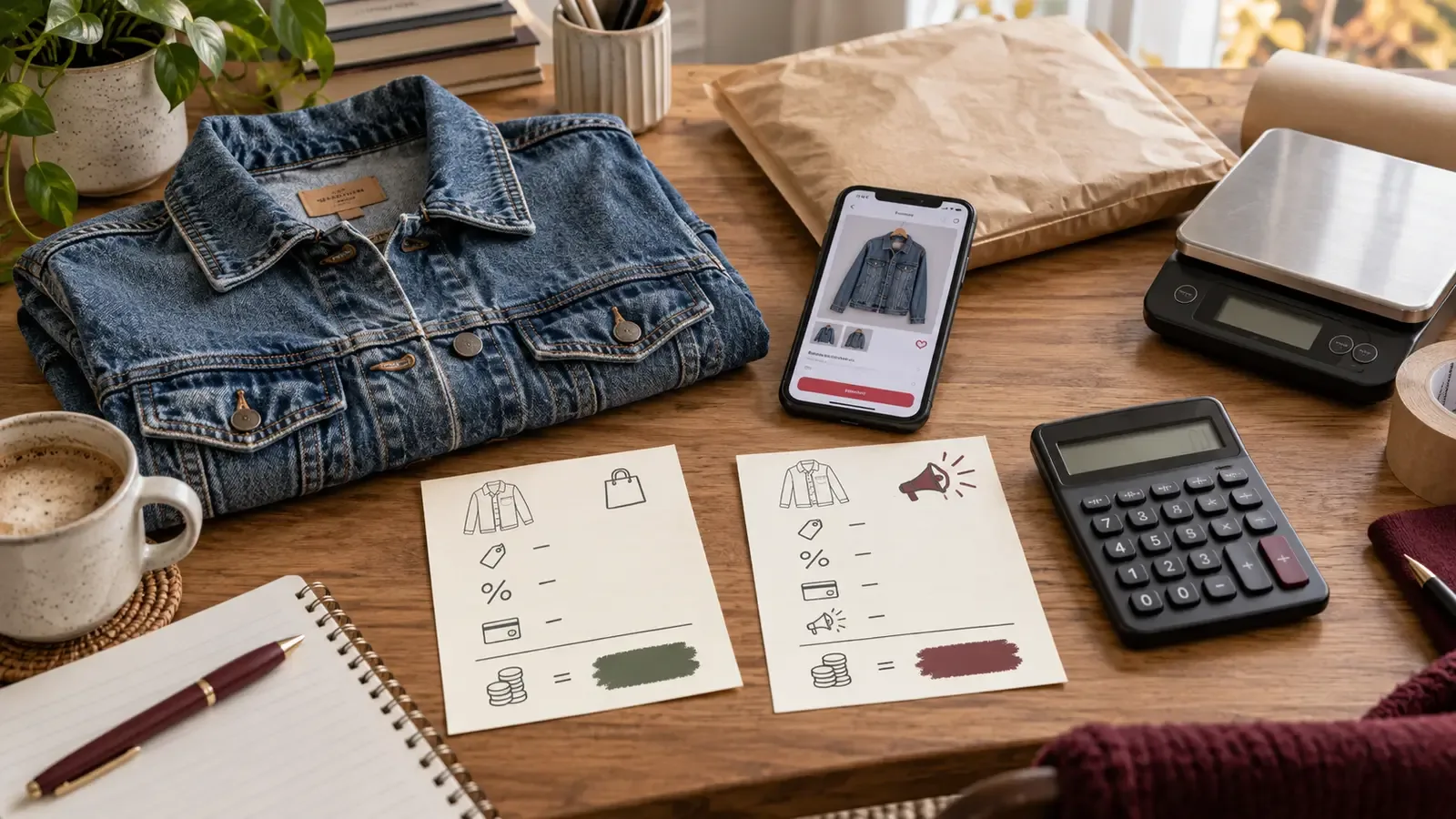
Depop does not charge a standard selling fee to sellers based in the United States, United Kingdom or Australia. Those sellers still pay payment processing: currently 3.3% + $0.45 in the US, 2.9% + £0.30 in the UK and 2.6% + A$0.30 in Australia. Sellers outside those three markets generally pay a 10% Depop selling fee as well as location-dependent PayPal processing. Optional promotion can be the biggest extra cost: eligible UK and US Boosted Listing sales are charged 12% under the policy effective 23 March 2026.
That means “zero selling fees” does not mean “zero deductions.” Your payout depends on your market, payment processing, whether a boost receives credit for the sale, shipping method and the item’s real cost. Use the Depop Fee Calculator to test your own numbers. For a US, UK or Australian sale, change its editable marketplace-fee field from the legacy 10% default to 0%; for an eligible UK or US boosted sale, use 12% in that field as a simplified boost estimate.
Depop seller fees at a glance
| Seller location | Standard selling fee | Payment processing | Boosting fee |
|---|---|---|---|
| United States | 0% | 3.3% + $0.45 | 12% on an attributed sale |
| United Kingdom | 0% | 2.9% + £0.30 | 12% on an attributed sale |
| Australia | 0% | 2.6% + A$0.30 | 8% on an attributed sale |
| Other markets | Generally 10% | PayPal rate varies by location and account | Generally 8% on an attributed sale |
These are the rates shown in Depop’s official seller fees and charges table when checked on 5 October 2026. Depop can change rates, eligibility and fee bases, so confirm the receipt preview and current policy before pricing expensive stock.
How much do US Depop sellers keep?
For a standard US sale using Depop Payments, the simplified payout calculation is:
US payout = buyer payment − (buyer payment × 3.3% + $0.45)
Depop says the processing fee is calculated on the item price, shipping and applicable taxes. Because the tax amount varies by buyer location, an estimate that omits tax may be a little lower than the final processing charge.
| Item price | Shipping | Processing base* | Processing fee | Payout before seller costs |
|---|---|---|---|---|
| $20.00 | $5.00 | $25.00 | $1.28 | $23.72 |
| $40.00 | $7.00 | $47.00 | $2.00 | $45.00 |
| $75.00 | $0.00 | $75.00 | $2.93 | $72.07 |
*Examples exclude applicable tax and round to the nearest cent. Product cost, postage you fund, packaging, boosts and other business costs are not yet subtracted.
The fixed $0.45 matters most on cheap items. On a $10 fee base, the processing charge is $0.78, an effective 7.8%. On a $100 fee base, it is $3.75, or 3.75%. Bundling low-priced items can therefore reduce the fixed-charge burden relative to processing several separate sales.
How much do UK Depop sellers keep?
For a standard UK sale using Depop Payments:
UK payout = buyer payment − (buyer payment × 2.9% + £0.30)
A £40 item with £3.50 shipping creates a £43.50 processing base before any applicable taxes. The estimated fee is £1.56, leaving £41.94 before product cost, seller-funded postage, packaging and other expenses.
UK sellers should not copy the US fixed fee or percentage into a spreadsheet. Even small rate differences matter across hundreds of orders. Set the Depop calculator to a 0% marketplace fee, 2.9% payment rate and £0.30 fixed fee, then treat its currency symbol as pounds for the estimate.
What changed for Boosted Listings in 2026?
Depop’s current Boosted Listings Policy took effect on 23 March 2026. It sets a 12% boost fee in the UK and US and 8% in Australia. Depop’s fee table says the 12% UK/US rate applies to new listings from that date.
The attribution window is easy to underestimate. Depop says a boosting fee can apply when a buyer sees the boosted version of a listing and buys the item within 28 days. The buyer does not have to click the boosted tile; seeing it can count. Stopping a boost does not erase qualifying exposure that already happened.
The boost fee is charged on the item sale price excluding tax and on seller-arranged shipping. Depop says it is not charged on a Depop Shipping label. Payment processing is added separately.
A US boosted-sale example
Assume a US seller sells a jacket for $50 and arranges $7 shipping. Ignoring tax for a transparent estimate:
- Boost fee base: $57.00
- 12% boost fee: $6.84
- Payment processing: $57 × 3.3% + $0.45 = $2.33
- Payout before inventory and fulfilment costs: $47.83
The boost changes platform deductions from about $2.33 to $9.17. That does not make boosting automatically unprofitable, but it means the promoted sale needs enough additional demand or a sufficiently high margin to cover the extra 12%.
Calculate profit, not only payout
A payout is the money remaining after platform deductions. Profit also subtracts what the item and fulfilment cost you:
Profit = item price + buyer-paid shipping − platform fees − product cost − seller-funded postage − packaging − other variable costs
Suppose a US seller sources a vintage jacket for $14, sells it for $50 with $7 buyer-paid shipping and spends $1 on packaging. If the sale is not boosted and the seller’s actual postage cost is $7:
- Buyer payment before tax: $57.00
- Estimated processing: $2.33
- Product cost: $14.00
- Postage: $7.00
- Packaging: $1.00
- Estimated profit: $32.67
If the same sale attracts a 12% boost fee, estimated profit falls to $25.83. Check the percentage with the Profit Margin Calculator, and read the distinction between gross and net profit before treating one successful sale as business-level earnings.
Set an offer floor before holiday discounts
Q4 buyers often expect offers, bundles and price drops. Work backwards from the profit you need instead of discounting from an arbitrary list price.
For a standard US sale with no boost and no tax in the estimate:
Minimum item price = (costs + desired profit + $0.45 − buyer-paid shipping × 0.967) ÷ 0.967
If product, postage and packaging total $22, you want $20 profit and you charge no separate shipping, the minimum price is about $43.90. A practical floor might be $44. If that item could be sold through a 12% boost, use a combined variable deduction of about 15.3% plus $0.45 for a conservative simplified estimate:
Boosted minimum price ≈ (costs + desired profit + $0.45) ÷ 0.847
With the same $42 cost-plus-profit target, the boosted floor is about $50.12. Use the Discount & Sale Price Calculator to compare 10%, 15% and 20% offers with that floor before accepting them.
When boosting can make sense
A boost should be tested like advertising, not treated as a default listing setting. It is more defensible when:
- The item has enough dollar margin to absorb 12% without crossing your offer floor.
- Organic impressions are low even though the title, category, brand, measurements and photos are accurate.
- The product is seasonal and the cost of missing the selling window may exceed the advertising fee.
- You measure attributed sales, profit and sell-through rather than views alone.
Organic listing quality still matters. Improve the title and searchable attributes with the Listing Title & Tag Optimizer before paying to amplify a weak listing. Clear measurements, flaw photos and condition notes also help reduce avoidable disputes; the Return & Refund Cost Calculator can show what one failed order does to margin.
How Depop compares with Poshmark and Mercari
The old shortcut that Depop always takes roughly 10% is no longer correct for US, UK and Australian sellers. In those markets, an unboosted Depop sale can have a much lower headline deduction than a marketplace charging a standard seller commission. But buyer demand, likely selling price, shipping options and return risk can outweigh the fee difference.
Compare the same item at its realistic final sale price across channels. The Depop, Poshmark and Mercari comparison provides a starting framework, while the dedicated Poshmark fee guide and Mercari fee guide cover their current calculations.
Depop fee FAQ
Does Depop charge sellers 10%?
Not in the United States, United Kingdom or Australia under the policy checked on 5 October 2026. Sellers in those markets pay no standard Depop selling fee, although payment processing and optional boost fees can apply. Sellers outside those markets generally pay a 10% selling fee.
What are Depop’s US payment processing fees?
Depop currently lists 3.3% + $0.45 for US Depop Payments. The percentage is applied to the item price, shipping and applicable taxes.
What are Depop’s UK payment processing fees?
Depop currently lists 2.9% + £0.30 for UK Depop Payments, calculated on the item price, shipping and applicable taxes.
How much does Depop boosting cost?
The current rate is 12% for attributed sales in the UK and US and 8% in Australia. Depop says a buyer’s view of a boosted tile can create a 28-day attribution window, even if the seller later stops boosting.
Are fees refunded when a Depop sale is refunded?
Depop’s current fee guide says selling, payment-processing and boosting fees are reversed when a sale is refunded. Depop Payments reversals are automatic; eligible PayPal transactions outside the UK, US and Australia may require a support ticket for the Depop selling-fee refund.
Is the buyer marketplace fee deducted from the seller?
No. Depop describes the marketplace fee in the UK, US and Australia as a buyer charge. It can still affect the buyer’s total checkout price and willingness to accept your listing price, so it matters commercially even though it is not deducted from your payout.
Bottom line
For most US, UK and Australian sellers, payment processing—not a standard 10% seller commission—is now the baseline Depop deduction. The larger decision is whether a 12% UK/US boost can earn enough incremental sales to justify its cost. Set the correct market rates, calculate from the expected accepted price, and keep a separate floor for boosted sales before the holiday offer season accelerates.
Policy check: 5 October 2026. Sources: Depop’s official Seller fees and charges, Boosted Listings guide and Boosted Listings Policy. Rates and eligibility can change; check the latest Depop receipt and policy for your market.