
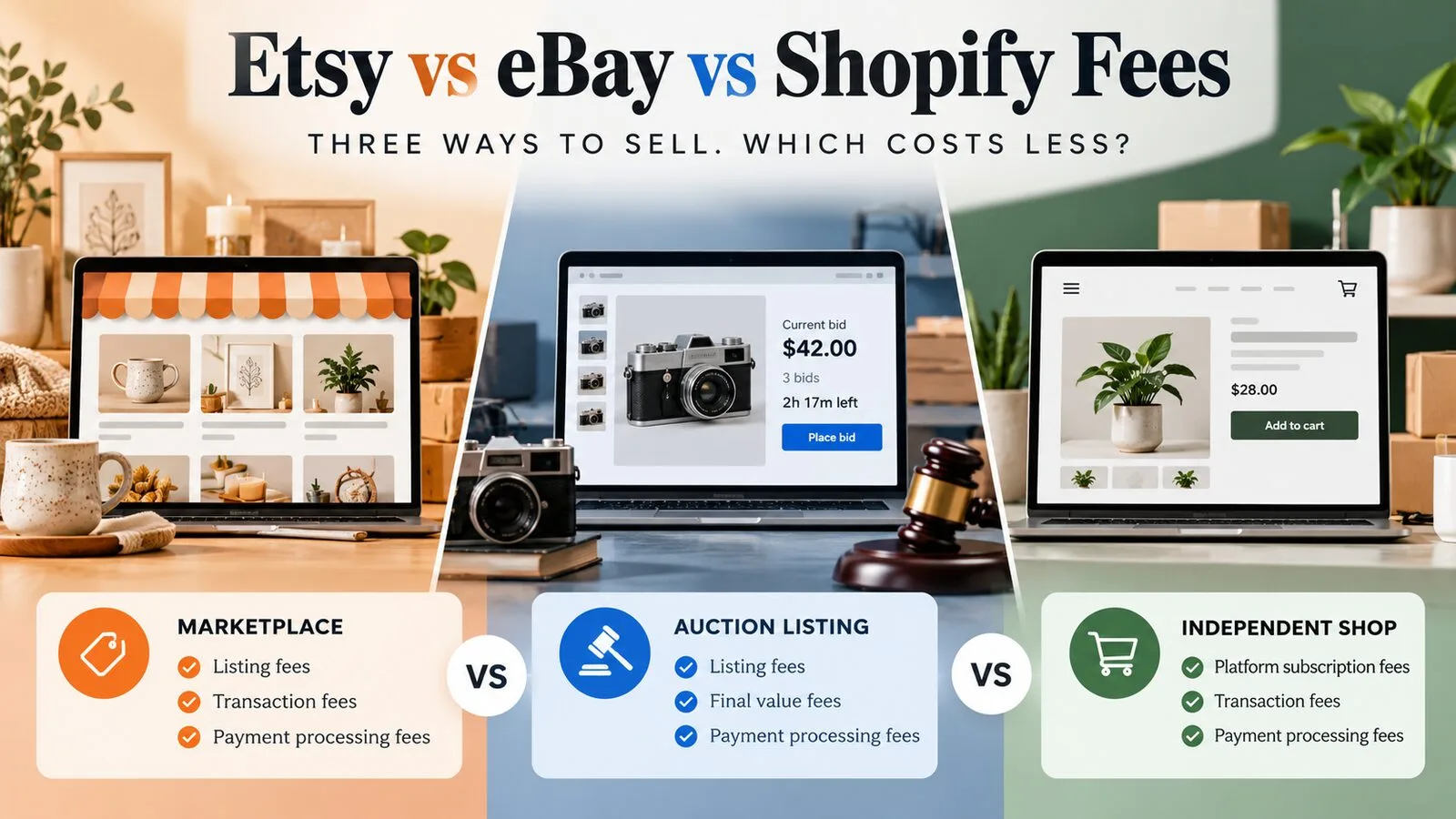
Etsy takes roughly 11 to 15 percent of an order before ads, eBay around 12 to 16 percent, and Shopify charges no commission but bills a monthly subscription plus about 2.9 percent plus $0.30 in payment processing. Which is cheapest depends almost entirely on your volume.
The structural difference
Etsy and eBay are marketplaces. They bring you buyers and take a percentage. Shopify is a storefront. It charges rent and leaves you to find the buyers yourself.
That single distinction matters more than any individual fee. A marketplace fee is expensive traffic. A Shopify subscription is cheap infrastructure with no traffic attached.
On a $40 order
- Etsy: $0.20 listing, 6.5 percent transaction on item plus shipping, plus roughly 3 percent and $0.25 processing. Around $4.30 to $4.60 in total.
- eBay: final value fee near 13.6 percent of the total sale plus $0.30 to $0.40 per order. Around $5.80.
- Shopify: about $1.46 in processing, plus your monthly subscription spread across however many orders you take.
Shopify looks unbeatable until you divide the subscription by ten orders a month. Then it is the most expensive option on the list. At five hundred orders it is not close.
Run your own numbers with the Etsy, eBay and Shopify calculators rather than trusting an average.
The break-even question
The useful way to frame it: how many orders per month does it take before a subscription beats a commission? Divide your monthly Shopify cost by the commission you would have paid per order on a marketplace. That is your crossover point. Below it, stay on the marketplace. Above it, your own store is cheaper and you keep the customer relationship too.
The Break-Even Calculator handles the fixed-versus-variable arithmetic if you want it laid out properly.
Why most sellers should not choose
Marketplaces give you traffic you cannot buy cheaply anywhere else. Your own store gives you margin and a customer list nobody can take away. The common pattern that works is to use marketplaces to find demand, then build a store for repeat buyers, and accept that the two do different jobs.
What does not work is spreading yourself thin across five platforms with no idea which is profitable. Pick one marketplace, learn its fee structure properly, and add the second only when the first is working.
The fees nobody puts in the comparison
Advertising. On every platform, organic visibility is falling and paid placement is increasingly how you get seen. Etsy Offsite Ads can add 12 to 15 percent on affected orders, eBay Promoted Listings adds an ad rate, and Shopify traffic has to be bought outright. Whatever comparison you make, do it with a realistic ad cost included or you are comparing fiction.